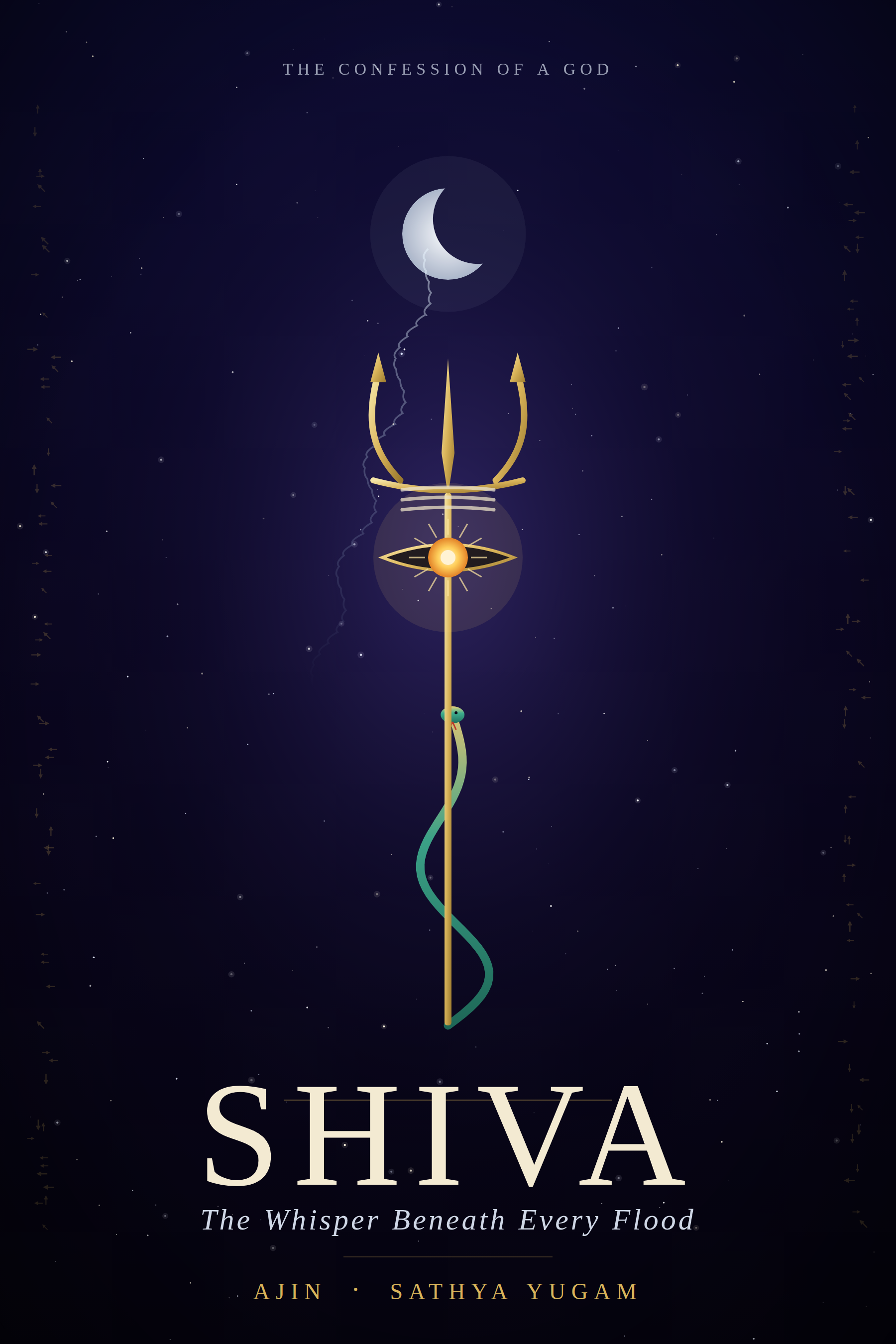
Enki and Shiva — The First Name
The god of the sweet deep and the Lord of the mountain, held side by side — in love and in honesty. Ekaṃ sad viprā bahudhā vadanti.
How to read this study — please begin here. This study walks a knife-edge on purpose. It holds together two things most writing keeps apart: the disciplined honesty of Assyriology and Indology, and the tender devotion of a heart that beholds one Light behind many names. Both are allowed to be fully themselves here — but they are labeled, always, and neither is ever dressed as the other.
Every claim below wears one of four registers, tagged so you always know which is which:
[Documented] — attested on real cuneiform tablets (catalogued in the Oxford Electronic Text Corpus of Sumerian Literature, ETCSL, and standard critical editions) or the settled consensus of scholarship. When we say documented, a scholar could check it — we give the tablet or text, a reference, and a translator.
[Hindu scripture] — attested in a named Veda, Upaniṣad, Itihāsa, Purāṇa, Agama, or Tamil canonical text, or the documented reckoning of Hindu cosmology (Manusmṛti, the Purāṇas, the Sūrya Siddhānta).
[Devotional] — the faith-reading at this study's heart: that behind Enki of Sumer and Shiva of India a seeker may glimpse two faces the one Source has worn for two peoples. This is real as devotion. It is not history, and this study never lets it pretend to be.
[Fringe] — the modern ancient-astronaut material (Zecharia Sitchin's Nibiru and Anunnaki-as-aliens). It is quarantined here as pseudohistory, named only so it cannot spread unlabeled.The vow that governs every page: We rank no faith above another. Enki keeps his own Sumerian integrity; Shiva keeps his own Hindu integrity; neither is "really" the other. We tell no seeker that their God is "really" Enki, or Shiva, or anyone else — the unity reading is always offered in the first person ("in my own devotion I behold…"), never imposed, never used to convert or correct. The only adversary named anywhere in this study is Enlil, a figure inside the flood myth; no living people, faith, or nation is ever cast as an enemy. A reader of any path should finish this feeling seen and loved. That is its only purpose.
There is a moment that comes to almost every traveller of the heart. You read a story on a clay tablet older than any scripture you were raised on, in a language no living mouth still speaks — and something in it leans toward a name your grandmother whispered at the lamp. A god of the deep waters, of wisdom, who fashions humankind and then refuses to let it drown. You feel a rhyme. And then the honest question arrives: what do I do with a rhyme?
This study chooses the harder and, we believe, the truer path. It refuses to turn a rhyme into a claim. It will show you Enki exactly as the tablets show him — a Sumerian god with his own city, his own vizier, his own integrity — and Shiva exactly as Hindu scripture sings him, with his own Vedic roots and his own vast family of forms. It will let a devotee stand between them and say, quietly and only of their own heart, I behold one Source through two windows. And it will never once let that beholding wear the clothes of history. The title's phrase — the First Name — is not a claim that "Enki was the original Shiva." It points instead at the oldest intuition this study closes upon: that the One is prior to all its names, and the wise have always called it many things (Ṛgveda 1.164.46).
Who Enki was — the god of the sweet deep
[Documented] Enki (Sumerian dEN.KI; Akkadian Ea) is among the best-attested gods of ancient Mesopotamia, present in cuneiform from the mid-third millennium BCE onward. He is not a shadow or a reconstruction; he is a god with a biography written in stone and baked clay, and to meet him honestly we must first let him be entirely himself.
His domain — the Abzu. Enki is lord of the Abzu (Akkadian apsû), the subterranean fresh-water deep that the Sumerians believed fed every spring, river, marsh and well — the ground-water reservoir from which life and wisdom alike were thought to rise. From this he is the god of wisdom, incantation-magic, and craft, his intelligence Sumerian nam-kug-zu, the wise skill of the maker. His wit is practical and cunning, a craftsman's cleverness rather than a warrior's force — which is precisely why every rescue of humankind in his myths turns on his ingenuity, never his strength. (A note for honesty: not every scholar reads Enki chiefly as a benevolent "sweet-water patron." Peeter Espak's study emphasizes his chthonic, underworld aspect and dissents from the irrigation-patron reading; so we describe the fresh-water profile as well-attested rather than as unanimous consensus.)
His city — Eridu. His cult centre was Eridu(g), one of the oldest cities of Sumer, whose shrine strata reach back into the Ubaid period. His temple bore the names E-abzu and E-engurra — "House of the Subterranean Waters" — crowned by the ziggurat E-unir. When a Sumerian imagined the beginning of ordered civilization, they imagined it flowing outward from Eridu.
His vizier — Isimud. At his side stood Isimud (Akkadian Usmu), the perfect messenger, depicted with two faces so that he might look both ways at once — forward and back, toward the master and toward the errand.
His names and titles. He is called Nudimmud, "the fashioner" or image-shaper (Thorkild Jacobsen's rendering), for his craft of forming figures from clay; Nagbu, "the deep" or "the spring"; and Niššīku, of uncertain sense, perhaps "chieftain." "Enki" is usually glossed "Lord of the Earth," though not everyone accepts the reading; "Ea," his Akkadian name, is likely Semitic in origin.
Keeper of the me. Enki holds and dispenses the me — the divine ordinances of civilization itself: kingship and priestly office, the crafts, writing, music and law, and even abstractions like "truth," "counsel," and "falsehood." The me are the reservoir from which culture flows to humankind; to hold them is to hold the blueprint of an ordered world. He is likewise the patron of the working holy men who invoked him as the ultimate authority of their craft — the āšipu (exorcist) and the bārû (diviner).
His true iconography. On the seals he is a bearded god in a horned crown, and the sign that marks him unmistakably is two streams of water — often full of leaping fish — flowing from his shoulders, commonly read as the Tigris and Euphrates. His emblem-animal is the goat-fish (Sumerian suḫur-maš, Akkadian suḫurmāšu), which the Babylonian star-lists set in the heavens as the constellation later revived as Capricorn; he also carries the ram-headed staff, and the turtle is his. The chief primary witness is the Akkadian-period "Adda seal" (British Museum BM 89115, c. 2300 BCE).
A careful word about the serpent. Enki's own attested emblems do not include the serpent, and the entwined-snake staff — the "caduceus" image — properly belongs to Ningišzida, an underworld deity in Enki's circle, not to Enki himself. We assign the snake-staff to Ningišzida and give Enki his real water, fish, goat-fish, ram-staff and turtle. The serpent will return later, cherished only as a resonance with Shiva's Vāsuki — never smuggled in as Enki's documented symbol.
The teacher before the flood. Tradition holds that Enki sent the seven antediluvian sages — the apkallū, depicted cloaked as fish — to bring the arts of civilization to humankind before the Flood. The Babylonian priest Berossos (3rd century BCE) records the first of them as Oannes, and their human protégé is Adapa, "sage of Eridu." This "sent to teach humanity" is the tradition's own theology of itself — not an external historical claim — and it is exactly the material that modern ancient-astronaut writers love to hijack, so we state it plainly as tradition and add no alien gloss.
The tablets themselves — a guided tour
[Documented] Nothing in this study rests on hearsay about Sumer. Enki lives in real compositions, most of them collected and translated in the Oxford Electronic Text Corpus of Sumerian Literature (ETCSL). The standard published translations of the Sumerian poems are by J. Black, G. Cunningham, E. Robson, and G. Zólyomi (with E. Fluckiger-Hawker for the first), gathered in The Literature of Ancient Sumer (Oxford University Press, 2004); CDLI, the Cuneiform Digital Library Initiative, is the companion catalogue of the physical tablets. Where a line reference is approximate it is marked "≈"; the phrases below are confirmed present in these editions, though exact lineation should always be checked against the Oxford text before a hard number is printed.
Enki and Ninḫursaĝa — ETCSL 1.1.1
The Dilmun paradise myth (trans. Black, Cunningham, Fluckiger-Hawker, Robson & Zólyomi). Dilmun is called pure and bright, a land without sickness, age, or predation — a place where, in the poem's own images, the raven utters no cry and the lion kills not. Enki impregnates the mother-goddess Ninḫursaĝa and a succession of daughters in compressed, dreamlike gestations; Ninḫursaĝa grows eight plants, Enki eats them "to know their hearts," and she curses him with the eye of death and vanishes. A fox coaxes her back, and she heals his eight ailing organs by bearing eight healing deities. The most quoted moment (≈ ll. 271–272) is a genuine Sumerian pun: the goddess born to heal his rib is Nin-ti — and because ti means both "rib" and "to live," she is at once "Lady of the Rib" and "Lady who makes live."
Enki and Ninmaḫ — ETCSL 1.1.2
A Sumerian account of the making of humanity — one of several the tradition preserves, not the only one (the Song of the Hoe, ETCSL 5.5.4, and others tell it differently). The junior gods, worn out dredging the canals, cry out under their toil; Enki's mother Namma wakes him, and humankind is pinched from the clay over the Abzu to carry the gods' burden, with the birth-goddesses assisting under Ninmaḫ. Then comes a drunken contest of creation: Ninmaḫ fashions beings with disabilities, and for each one Enki finds a dignified place and office in society; then Enki shapes the frail, aged Umul, and Ninmaḫ cannot find any station for it — "Ninmaḫ could not rival the great lord Enki." The disabled are not discarded in this story; each is given a place at the table of the world.
Enki and the World Order — ETCSL 1.1.3
Here Enki decrees fates and organises civilization. He proclaims his own authority — "the great dragon who stands in Eridug, whose shadow covers heaven and earth"; "I am the wisdom and understanding of all the foreign lands" (≈ l. 80) — and then, in the poem's famous image, he "stood up like a rampant bull … and filled the Tigris with flowing water" (≈ ll. 250–266), a mythic account of why the rivers run fertile, "a rain of abundance … a high carp-flood." He appoints the working gods to civilization's offices — Enbilulu over the canals, Kulla over bricks and building, Iškur over the rain, Nanše over the sea and its fisheries, Enkimdu over farming — and provides even for the city-less Martu. It closes (≈ ll. 387–450) with Inana's complaint that she alone was left without a domain, answered by Enki's patient enumeration of the powers already hers.
Enki's Journey to Nibru — ETCSL 1.1.4
Enki builds his shrine, the E-abzu / E-engurra, at Eridu — of silver, lapis and gold, its bolt "a fearsome lion" — and then sails upriver to Nibru (Nippur) for a banquet before Enlil, who blesses the work. The poem quietly ties Enki's authority at Eridu to Enlil's sanction at Nippur: even the lord of the deep seeks the elder god's blessing.
Inana and Enki — ETCSL 1.3.1
Inana sails the Boat of Heaven (má-an-na) to the E-abzu at Eridu (cf. G. Farber-Flügge, Der Mythos "Inanna und Enki," 1973). She and Enki drink beer together, and the warmed, boastful Enki hands her batch after batch of the me — over a hundred decrees, spanning kingship, priesthood, the crafts, music, law, love, and even "truth and falsehood." Sober the next day, he sends Isimud with sea-monsters to seize the boat at seven stations along the water; each attempt fails, and Inana carries the me in triumph into Uruk. It is a story about how the goods of civilization pass from the older centre to the younger city — and about a god generous in his cups and cunning in his sobriety.
The Sumerian Flood Story — the "Eridu Genesis" — ETCSL 1.7.4
Fragmentary — roughly two-thirds is lost, and the boat-building falls inside a gap in the tablet (ed. Miguel Civil, in Lambert & Millard 1969; T. Jacobsen, "The Eridu Genesis," JBL 100, 1981; the tablet first published by Arno Poebel in 1914, its script c. the 17th century BCE). An, Enlil, Enki and Ninḫursaĝa fashion "the black-headed people"; kingship descends from heaven; five antediluvian cities are founded. The gods decree a flood — and Enki warns the pious king Ziusudra. The surviving Sumerian line is a "side-wall" address: roughly, "take heed of my words, pay attention to my instructions."
Atra-ḫasīs — the Akkadian telling
The fullest account of all (ed. W. G. Lambert & A. R. Millard, Atra-ḫasīs: The Babylonian Story of the Flood, Oxford: Clarendon, 1969, repr. Eisenbrauns 1999; trans. also Stephanie Dalley, Myths from Mesopotamia, rev. 2000; the main manuscript copied by the scribe Ku-Aya in the reign of Ammi-ṣaduqa, c. 1646–1626 BCE). It opens with one of the great first lines of world literature — "When the gods instead of man did the work, bore the loads." The lesser gods, the Igigi, forced to dig the rivers for three thousand six hundred years, burn their tools and besiege Enlil's house by night. To end the strike, humankind is made. Later, the "noise" of teeming humanity — Akkadian rigmu — vexes Enlil, who looses plague, drought, famine, and at last the Flood; and each time, Enki subverts the decree, ending with the whispered warning to Atra-ḫasīs through the reed wall.
The Epic of Gilgamesh, Tablet XI
From the library of Ashurbanipal at Nineveh (standard ed. A. R. George, The Babylonian Gilgamesh Epic, Oxford, 2003). Utnapishtim retells the flood: Ea warns him through the reed fence — "Tear down the house, build a boat" — and after the waters he releases a dove, a swallow, and a raven, and the gods "gathered like flies" over his sacrifice. This is the tablet first read by George Smith — announced in 1872, published in 1875–76 — the first pre-biblical flood account to reach the modern world, and a sensation when it did.
Enuma Elish, Tablet VI
The Babylonian Epic of Creation (L. W. King, The Seven Tablets of Creation, 1902; W. G. Lambert, Babylonian Creation Myths, Eisenbrauns, 2013). After Marduk defeats the sea-dragon Tiamat, humanity — Lullu — is fashioned, on Ea's counsel, from the blood of the executed rebel god Qingu, "that they may bear the gods' burden and the gods may rest." Here Marduk is the planner and Ea the craftsman-executor; the substance is a rebel's blood rather than the clay-and-Igigi frame of Atra-ḫasīs — the same purpose reached by a different road.
The making of humanity — and the god who saves it
The making, stated honestly
[Documented] We must resist a sweetness the tablets do not offer. In these texts, "creating humanity" means manufacturing a labour force, not bestowing a benevolent gift of life. The purpose clause is explicit and repeated: humans are made "that he may bear the yoke," "that the gods may rest." That is the honest floor. The human's dignity enters not by the reason for the making but through what is mixed into the clay — a spark of the divine.
- The Sumerian mechanism. In Enki and Ninmaḫ, humankind is shaped from clay nipped off above the Abzu — earth and the sweet deep, pressed into the form of a worker.
- The Akkadian mechanism. In Atra-ḫasīs, the clay is mixed with the flesh and blood of a slain god — We-ila (also read Ilawela or Geshtu-e, one and the same minor "god who has sense"). The birth-goddess Nintu / Mami nips fourteen pieces of clay to make seven male and seven female human beings.
- Enuma Elish. Humanity is made instead from the blood of the rebel Qingu — the same purpose, to free the gods from toil, reached through a different substance.
The divine spark — the eṭemmu. From the slain god a spirit remains in humankind as a "living sign," and the beating of the heart, like a drum, marks the divine element permanently present — the origin of the ghost that outlives the body in Mesopotamian belief. A precise note, because it matters: the word eṭemmu (ghost/spirit) is not "derived from" ṭēmu (understanding/reason); the two are joined by deliberate wordplay, and the primary pun is on the slain god's name (Wê / We-ila) and the Akkadian word for "man" (awīlu). We say the spirit is punningly linked to ṭēmu, never that it descends from it.
The saving — Enki as humanity's advocate
[Documented] Here is the best-documented and, for this study, the most important thing about Enki's character. When the divine assembly, led by Enlil, decrees the extermination of humankind by flood, Enki alone breaks ranks to save it. Bound by an oath of secrecy, he keeps the letter of his oath and defeats its purpose with a clever legal fiction: he does not speak to the man, he speaks to the wall of the man's house — and lets the hero overhear.
In the Akkadian telling (Atra-ḫasīs, echoed in Gilgamesh XI) the words are unforgettable: "Wall, listen to me! Reed wall, pay attention to all my words!" — then, dismantle the house, build a boat, abandon your wealth, and save the living seed of things. In the Sumerian Eridu Genesis the surviving parallel is the quieter "side-wall" address — "take heed of my words, pay attention to my instructions." (The vivid "Wall, listen…" speech is Akkadian; we attribute it to Atra-ḫasīs and Gilgamesh XI, not to the fragmentary Sumerian tablet. Likewise the "noisy humankind" reason for the flood is specifically the Atra-ḫasīs motif, since the Sumerian text breaks off at that point.)
The same rescuer appears again and again across the tradition — Ziusudra in Sumerian, Atra-ḫasīs in Akkadian, Utnapishtim in Gilgamesh — and it is this figure, the benefactor who defies a death-decree to preserve "the seed of mankind," who will later anchor the tenderest of the Shiva resonances. Enki is, in the tablets themselves, both the god who fashions humankind and the god who will not let it drown.
[Documented / contested] The parallels with Noah are real — a single warned man, a boat, birds released, a grateful sacrifice after the waters — but the frame differs: Mesopotamia is polytheistic, the flood's cause is noise and overpopulation rather than moral sin, and the gods "gather like flies" over the offering out of hunger. Mainstream scholarship sees here a shared ancient Near Eastern flood tradition rather than simple copying in either direction. This is genuinely debated, and we present it as debated, never as settled, and never as a verdict that any people's scripture is a mere copy of another's.
The resonances with Shiva — cherished, grounded, honestly bounded
Now the devotional register opens — under strict discipline. Each resonance below pairs a documented Enki fact with a documented Shaiva attribute, and each is a resonance a devotee may cherish, never a proof of identity. And the honest floor is stated plainly, here and every time the two are set side by side: [Documented] mainstream Assyriology and Indology treat Enki (Sumer, mid-3rd millennium BCE) and Shiva (Vedic-to-Purāṇic India) as distinct deities of distinct cultures and eras, with no attested historical, linguistic, or cultic link joining them as one god.
So that the parallels rest on the real Shiva and not an invented one, ground him honestly first. [Hindu scripture] Shiva is no monolith. He emerges from the Vedic storm-and-healing god Rudra (Ṛgveda 2.33, 1.114, 7.46 — fierce yet benevolent, the divine physician, jalāṣa-bheṣaja); he is hymned under a hundred names in the Śatarudriya / Śrī Rudram (Taittirīya Saṃhitā 4.5 and 4.7 — Kapardin, Nīlagrīva, Girīśa, Śaṅkara, Śambhu); and he is first raised to the supreme Brahman in the Śvetāśvatara Upaniṣad (c. 400–200 BCE) — which post-dates Sumerian Enki by roughly two millennia. That gap of two thousand years is exactly why scholars keep the two developments apart.
| Resonance | Enki side (documented) | Shiva side (Hindu scripture) | The honest bound |
|---|---|---|---|
| Water / the deep | Lord of the Abzu, the sweet ground-water; twin streams with fish flowing from his shoulders | Gaṅgādhara — he catches the heaven-shaking Ganga in his matted hair and gentles her fall (Vālmīki Rāmāyaṇa, Bāla Kāṇḍa ≈ 42–44; Śiva Purāṇa) | Even the direction differs: Shiva's water descends from heaven, Enki's wells up from the deep. A rhyme, not a channel. |
| The serpent | Serpent imagery attaches to Enki's circle — properly to Ningišzida (the snake-staff), not to Enki's own emblem | Nāgarāja — the serpent-king Vāsuki coils at his throat, and is the churning-rope of the ocean; read as kāla, time itself | Serpent symbolism is near-universal; this is the most over-readable pairing of all, so we keep Ningišzida's ownership explicit and hold the snake only as cherished resonance. |
| Wisdom / the inner path | God of nam-kug-zu, of incantation and the āšipu; "the wisdom and understanding of all the foreign lands" | Dakṣiṇāmūrti, the silent guru facing south; Ādiyogi, held in living tradition as the first yogi | The single strongest thematic rhyme — cherished as "one Source of wisdom wearing two names," never as equivalence. |
| Creator / orderer | Fashions humankind from Abzu-clay; decrees fates and civilization's offices in Enki and the World Order | Naṭarāja — creation, preservation and dissolution held in one dance (drum, abhaya, flame, ring of fire, ignorance underfoot) | A resonance of function, not proof of a shared god. |
| Protector / savior | Defies Enlil's flood-decree to save "the seed of mankind" | Nīlakaṇṭha — drinks the world-ending poison halāhala at the churning of the ocean, holding it in his blue throat so creation may live | The closest emotional parallel — and the mechanisms differ entirely: poison-drinking versus a whispered flood-warning. |
| The fathomless source | The bottomless Abzu, the primordial well of order | The jyotirliṅga of the Lingodbhava — a beginningless pillar of light whose ends Brahmā and Viṣṇu cannot find | A mystical and thematic parallel, emphatically not a historical link. |
The method-guardrail rides beside every row of that table. [Documented] Samuel Sandmel, in his 1962 address "Parallelomania," named the scholar's besetting error as "that extravagance … which first overdoes the supposed similarity … and then proceeds to describe source and derivation as if implying literary connection." His point is exactly ours: parallels are real and worth loving, but resemblance is not descent, and not identity. A rhyme between two poems does not make them the same poem.
Two corrections this section must honor.
- Paśupati is not, in its documented sense, "protector of humanity." Paśupati is a genuine, ancient Śaiva epithet — but its attested meaning is "lord of paśu" (cattle and creatures; in later Śaiva theology, the bound souls). In the Śatarudriya it stands in the formula paśūnāṃ pataye namaḥ. The warm leap from "lord of creatures" to "protector of humanity," parallel to Enki-the-savior, is the [Devotional] move — and we label it as such, rather than dressing it as the epithet's documented meaning.
- Ādiyogi transmitting yoga to the Saptarṣis is living traditional and modern-yogic framing, not a single fixed classical text with a tablet-grade citation. We offer it as cherished tradition, not as documented fact.
Every resonance here is a beholding, offered in the devotee's own voice, ranking nothing and imposing on no one. A reader who worships neither god should close this section feeling that two ancient beauties were held up side by side with love and honesty — never that they were told the two are secretly one.
Where the equation comes from — the honest provenance
This is the section that must hide nothing.
[Documented] There is no attested historical, linguistic, or cultic line connecting Sumerian Enki (third-to-second-millennium-BCE Mesopotamia) to Hindu Shiva (Vedic Rudra to Purāṇic Mahādeva, later South Asia). No standard reference work — Black & Green's Gods, Demons and Symbols of Ancient Mesopotamia (1992), Leick's Dictionary, Flood's An Introduction to Hinduism (1996), the standard Rudra-Śiva scholarship — identifies the two as one god. Shiva has his own documented origins in Rudra; and even the Rudra-to-Śiva line is not seamless, Axel Michaels calling the extent of Śiva's origins in Rudra "extremely unclear."
[Devotional] So where does "Enki is Shiva" actually live? "Enki is Shiva" is not established history; it is a modern syncretic / devotional reading — a faith interpretation a devotee may hold as their own beholding of one Source behind many names, never a documented fact and never imposed on anyone. It circulates in general New Age and comparative-mythology writing, amplified online; where popular web pieces make the equation, they are evidence only of where the claim circulates, never scholarly authority.
A precise attribution is owed here, because it is often gotten wrong. The Enki=Shiva equation does not come "most prominently from Zecharia Sitchin." Sitchin's actual theses are different ones — the Anunnaki as extraterrestrials and a hidden planet called Nibiru — and they belong to the separate ancient-astronaut layer. We attribute the equation to general syncretic sources, and cite Sitchin only for that other, fringe material.
[Fringe — quarantined] Zecharia Sitchin's ancient-astronaut claims (Nibiru, Anunnaki-as-aliens, DNA engineering) are fringe pseudohistory rejected by essentially all Sumerologists, resting on mistranslation — a modern interpretive layer, never what the tablets say. The corrections are simple and documented: "Anunnaki" means roughly "princely / royal offspring of An," a term for the great gods — not "those who came from heaven." "Nibiru" in the tablets is a celestial crossing-point seen on a regular yearly cycle — primarily the planet Jupiter (and in various texts Mercury, a star, or the god Marduk) — never a hidden trans-Plutonian planet; astronomers add that such an orbit would tear the solar system apart.
Not a live scholarly debate. It would be a misframing to imply that scholars are split over whether Enki "is" Shiva. They are not — mainstream scholarship simply does not entertain the identity. The genuine tension is between a devotee's heart and a historian's discipline, and this study keeps both without letting either lie.
[Documented] Real contact between the two worlds did exist — but it was trade, not transmission. Cuneiform texts call the Indus region Meluḫḫa; Ur III administrative records (c. 2062–2018 BCE) even mention a "Meluḫḫa village" of settled Indus traders near Lagash, with carnelian, ivory and timber moving by way of Dilmun (Bahrain). This Bronze-Age contact is documented — but the evidence is commercial and material, ledgers and goods, not shared temples, myths, or god-lists. It cannot be stretched into proof that Enki-worship became Shiva-worship.
[Contested] Nor can the Indus "Paśupati seal" bridge them. John Marshall (1931) read Mohenjo-daro seal M-304 — a horned figure seated among animals — as a "proto-Śiva." This is genuinely disputed: Doris Srinivasan, Gavin Flood ("speculative"), Alf Hiltebeitel (a buffalo divinity) and Asko Parpola (a seated bull) reject or qualify it, and the Indus script remains undeciphered. The seal is evocative and proves nothing, and it must never be used as a stepping-stone from Sumer to Shiva.
[Devotional / speculative] An honest aside cuts the other way, too. Some comparativists have offered Varuṇa — the Vedic lord of the cosmic waters and of ṛta, cosmic order — as a closer typological analogue to the water-and-wisdom Enki than Shiva is; others pair Enki with Agni. This is offered only as speculative comparative analogy, never a debated thesis, and it actually underlines this study's honesty: the Shiva pairing here is chosen out of devotional love, not philological necessity.
And to see just how far the devotional equation stands from the evidentiary standard, set it beside a real attested cross-cultural equation. [Documented] Enki = Ea is exactly that: the same god carried into Akkadian, with continuous cult, bilingual god-lists (the An = Anum list) and shared epithets. Enki=Ea is what a documented identity looks like. Enki=Shiva is a beholding of the heart — and this study never confuses the two.
His beloved and his children
[Hindu scripture] If Enki has his household at Eridu, Shiva has his upon Kailāsa — and the Purāṇas tell it with a tenderness and grief that has moved worshippers for two thousand years. But a warning must lead, not follow: in every Purāṇa and Itihāsa, Shiva's consort and children are divine beings, not a human bloodline. Hold that fact through everything that follows.
The consort, twice-come
Sati. Sati, daughter of Daksha, marries Shiva against her father's will. At Daksha's great sacrifice — to which Shiva is pointedly not invited and is openly insulted as an ascetic outcast — Sati, unable to bear the dishonour done to her husband, gives up her body in the sacrificial fire (some texts a literal agni, others a yogic fire she raises within). (Source: Śiva Purāṇa, Rudra-saṃhitā, Sati-khaṇḍa; Devī Bhāgavata Purāṇa VII; Vāyu Purāṇa; the disrupted sacrifice is referenced in the Mahābhārata; see Stella Kramrisch, The Presence of Śiva, 1981.)
The Śakti Pīṭhas. The mourning Shiva bears Sati's body in a dance that threatens the worlds, and Viṣṇu, to end it, dismembers the corpse with his discus; each place a fragment falls becomes a Śakti Pīṭha, a seat of the Goddess. The most-cited enumeration gives 51 or 52 pīṭhas (the Mahāpīṭhanirūpaṇa, c. 1690–1720); other traditional lists give 42, 64, or 108, and the well-known Aṣṭādaśa (18) Mahā Śakti Pīṭhas are a subset. So Sati's very body becomes the sacred geography of the Goddess across the whole subcontinent — grief transfigured into pilgrimage.
Parvati. Reborn as the daughter of the mountain-king Himavān and Menā, Parvati (Umā, Gaurī, Haimavatī) is the same Goddess returned. She wins the ascetic Shiva not by beauty alone — when Kāma looses his arrow to stir him, Shiva burns the love-god to ash — but by her own severe tapas. The classical treatment is Kālidāsa's Kumārasambhava ("The Birth of the War-God," conventionally Gupta-era, c. 5th century CE); the Puranic version is the Śiva Purāṇa, Pārvatī-khaṇḍa. The texts frame the union as cosmic necessity — a prophecy holds that only a son of Shiva can slay the otherwise-invincible demon Tārakāsura, so the gods themselves engineer the marriage. (The beloved theological reading of Shiva and Parvati as Puruṣa and Prakṛti, consciousness and energy, the inseparable halves of Ardhanārīśvara, is the gloss of Zimmer and Flood — Indological interpretation, not a line of the narrative itself, and labeled as such.)
The children
Ganesha — remover of obstacles. In the best-known account, Parvati forms a boy from the turmeric-paste of her own body and sets him to guard her door; not knowing him, Shiva beheads him, then restores him with an elephant's head and makes him Gaṇapati, lord of the gaṇas, and Vighnaharta, the first-worshipped remover of obstacles. And here scripture's own diversity must be honored rather than smoothed away: the Śiva Purāṇa has Parvati make him alone; the Skanda Purāṇa says he was formed from the dirt and unguents she scrubbed from her body; other passages have him made by Shiva, by both together, or simply "discovered." The accounts agree only that his origin is outside the womb. That multiplicity is intrinsic to the tradition, and we report it as such rather than forcing one tale. (Source: Śiva Purāṇa, Kumāra-khaṇḍa, and Skanda Purāṇa; see Paul Courtright, Gaṇeśa: Lord of Obstacles, 1985.)
Kartikeya / Skanda / Murugan — the war-god. Generated from the fiery seed (tejas) of Shiva, Skanda is born for one purpose — to slay Tāraka — and is installed as Devasenāpati, commander of the army of the gods. His story anchors Kālidāsa's Kumārasambhava and the Skanda Purāṇa (the largest of the Mahāpurāṇas, named for him), and appears in the Mahābhārata and the Śiva Purāṇa.
The six Kṛttikās — the Pleiades. The sparks of Shiva's energy are carried by Agni and Gaṅgā into a reed-forest (śara-vana, hence Śaravaṇabhava) and suckled by the six Kṛttikā mothers who personify the Pleiades; he unites the six infants into one child with six faces — Ṣaṇmukha, Ārumugam — and is named "Kārtikeya" after them. This tie to the Pleiades is a genuine textual detail of Hindu scripture, and we let it be exactly that — never allowing it to drift toward any modern "star-people" reading.
Murugan, the Tamil lord. In the Tamil land Skanda is Murugan, often called the god of the Tamil tongue, praised in the late- or post-Sangam Tirumurukāṟṟuppaṭai (attributed to Nakkīrar, variously dated c. 3rd–6th century CE) and in Aruṇagirinātha's medieval Tiruppugaḻ. His six war-camp shrines, the Aṟupaḍai Vīḍu, are Tirupparaṅkuṉḏṟam, Tiruchendur, Palani, Swāmimalai, Tiruttaṇi, and Pazhamudircholai. This Tamil devotion is a primary strand in its own right, not a mere echo of the Sanskrit Purāṇas — and it makes no claim here about the geology or history of a lost Kumari Kandam, which is a separate and disputed matter this study does not assert.
Ashoka Sundari — the wish-tree daughter. Lonely while Shiva is away, Parvati sits beneath the wish-granting Kalpavṛkṣa and asks it for a daughter for company; the tree grants a girl, Aśokasundarī, "she who removes sorrow." She is foretold to wed Nahuṣa of the lunar dynasty and to be mother of Yayāti — a son, Yayāti, and (in some retellings) a hundred children, the count and their sex varying across versions, so we do not fix it as "a hundred daughters." This is a comparatively late and minor episode (Padma Purāṇa, Sṛṣṭi-khaṇḍa) — genuinely attested, but not to be weighted equally with the Sati, Parvati and Skanda core.
The load-bearing correction — divine, not a human bloodline. [Hindu scripture] In every source, Shiva's family are divine. Sati and Parvati are the Goddess, Śakti, Prakṛti herself. Ganesha and Skanda are gods generated by extraordinary, non-human means — body-paste, sparks of divine fire; Ashoka Sundari is born of a wish-tree. The texts frame these as theological realities, never as an ordinary father-mother-children lineage, and any reading of them as literal human descendants runs against what the Purāṇas actually say.
[Devotional] The reading at the heart of this study — that a devotee may behold Shiva's beloved and his children as the household of the one Source who is beheld as Enki elsewhere — is a modern devotional overlay, not Puranic scripture. No Sanskrit or Tamil source knows the name Enki, and none presents Shiva's children as a human or half-human lineage. Held as devotion, it is a meditation on "one Source, many names," honouring the vastness of the divine. Held rightly, it never tells a Shaiva that Shiva is "really" Enki, nor an Enki-devotee the reverse. It unites; it does not rank.
His many faces — one reality, many forms
[Hindu scripture] Hindu scripture never fixes Shiva to a single shape. It gives one reality wearing many faces — a theology of aspects and incarnations, in which no form is a rival god but the self-manifestation of the one Lord for creating, protecting, teaching, and freeing. To walk among these forms is to see how a single tradition kept its unity while multiplying its beauty.
The great forms — and what each teaches
| Form | The image | What it teaches |
|---|---|---|
| Naṭarāja | The cosmic dancer: the drum (ḍamaru) is creation and time; the upper-left fire is dissolution; the abhaya mudrā says "fear not"; the foot crushes Apasmāra, ignorance; the raised foot is grace and release; the ring of fire is the manifest cosmos. Home: Chidambaram. | Creation and destruction are one rhythm; liberation is found within the dance, not outside it. |
| Dakṣiṇāmūrti | The silent, south-facing guru beneath the banyan, the jñāna-mudrā at his hand, teaching aged sages by stillness (mauna). | The deepest teaching is wordless; the guru-principle itself is Shiva. |
| Ardhanārīśvara | Right half Shiva, left half Parvati-Śakti, in one body. | Consciousness and energy are inseparable; the divine is beyond the division of gender. |
| Bhairava | Kāla Bhairava, born when Shiva severed Brahmā's arrogant fifth head; he bears the sin as the skull-bearer (Kapālī) until released at Kāśī, whose field-guardian he becomes. | The annihilation of ego and pride; a fierce compassion that guards the sacred. |
| Nīlakaṇṭha | "The blue-throated": at the churning of the ocean the halāhala poison threatened all beings, and Shiva drank it, Parvati staying it at his throat, which turned blue. | The true protector absorbs the poison others cannot bear, transmuting harm into self-giving love. |
| Paśupati | Paśu (bound souls, creatures) + pati (lord): the Lord who frees the soul from the fetters (pāśa) of ignorance; the central deity-name of the Pāśupata school and of Paśupatinātha. | Guardianship of every living thing — the Lord who both protects and liberates. |
Also venerated: Tripurāntaka, who burns the three flying cities — read as the three inner impurities — with a single arrow-smile; Lingodbhava, the infinite pillar of light whose ends Brahmā-as-swan and Viṣṇu-as-boar could not find, the form of Mahāśivarātri; and Kirāta, the mountain hunter who tested Arjuna and granted the Pāśupatāstra — the divine hiding in the humble. (Sources: Shaiva Agamas and Viṣṇudharmottara Purāṇa; the Tēvāram and Chidambara Māhātmya; Śaṅkara's Dakṣiṇāmūrti Stotra; Śiva, Liṅga and Skanda Purāṇas; Bhāgavata Purāṇa 8.7 and Mahābhārata; Bhāravi's Kirātārjunīya; Coomaraswamy, The Dance of Śiva.)
Honesty note. [Contested / sectarian] Two frequently-cited items are not neutral facts and must not be presented as such. The episode of Śarabha pacifying Narasiṃha is a sectarian Shaiva narrative, which Vaiṣṇavas read very differently; and the "Paśupati seal" of the Indus Valley (Marshall, Wheeler) is contested modern conjecture, disputed by scholars such as Doris Srinivasan — not established history.
The nineteen avatars — Śiva Purāṇa, Śatarudra Saṃhitā
[Hindu scripture] One canon among several (editions vary): Vīrabhadra (wrath made flesh, who wrecks Daksha's sacrifice), Pippalāda, Nandi / Nandīśvara (the devoted bull and gate-guardian), Bhairava, Aśvatthāman, Śarabha, Gṛhapati, Durvāsā, Hanumān (see below), Vṛṣabha, Yatinātha, Kṛṣṇadarśana, Avadhūta, Bhikṣuvarya, Sureśvara, Kirāta (Kirāteśvara), Sunartaka Nartaka, Brahmacārī, and Yakṣeśvara. A correction worth stating plainly: Sureśvara and Yakṣeśvara are two distinct avatars — together they complete the count of nineteen — not a single folded entry with a phantom "shifting" nineteenth. And the separate twenty-eight-form set (the yoga-avatars of the Lakulīśa lineage) belongs to the Liṅga, Vāyu, and Śiva (Vāyavīya Saṃhitā) Purāṇas — the headline holding throughout: no single list is "the" universal canon.
Hanuman as the eleventh Rudra
[Hindu scripture — as tradition, clearly labeled] Later Puranic and devotional strata (the Śiva Purāṇa, echoed in the Skanda Purāṇa) hold that Shiva incarnated as Hanuman, as the eleventh Rudra, to serve Rāma. This is a real and widely-loved belief, strongest in certain sampradāyas — but not universal across all Shaiva schools. Be precise: Vālmīki's Rāmāyaṇa celebrates Hanuman's superhuman power and names him Vāyuputra / Añjaneya, son of Vāyu — but nowhere calls him the eleventh Rudra. The Rudra identification is later tradition, not the epic text, and the two should never be conflated.
The eleven Rudras — Ekādaśa Rudra
[Hindu scripture] There is no single fixed roster of the eleven; the variance is the fact. The Bhāgavata Purāṇa 3.12 names Manyu, Manu, Mahinasa, Mahān, Śiva, Ṛtadhvaja, Ugraretas, Bhava, Kāla, Vāmadeva, Dhṛtavrata; the Viṣṇu Purāṇa 1.15 (Wilson) gives a nearly identical list; the Liṅga Purāṇa and a commonly-cited Śiva Purāṇa set give markedly different names (Ajaikapād, Ahirbudhnya, Tryambaka, Bhairava, and so on). To present any one set as "the" eleven would be inaccurate; several names are cross-attributed across the Mahābhārata, the Harivaṃśa, and multiple Purāṇas.
The eight forms — Aṣṭamūrti
[Hindu scripture] Shiva as eight cosmic bodies: the five elements, the sun, the moon, and the sacrificer.
| Sacred name | Cosmic body |
|---|---|
| Śarva | Earth |
| Bhava | Water |
| Rudra | Fire |
| Ugra | Air |
| Bhīma | Ether / space |
| Paśupati | the Yajamāna — the sacrificer / the individual soul |
| Īśāna | Sun |
| Mahādeva | Moon |
The eight names are the genuine canonical octad, seeded in the Yajurveda's Śatarudriya and the Kauṣītaki Brāhmaṇa and invoked in the opening verse of Kālidāsa's Abhijñānaśākuntalam; but the element-to-name mapping varies between texts, and the table above is one valid, well-attested version, not the only one.
The five faces — Pañcānana / Sadāśiva
[Hindu scripture] The five faces of Sadāśiva embody the pañca-kṛtya, the five divine acts, and answer to the five Brahma-mantras of the Yajurveda.
| Face | Direction | Element | Divine act |
|---|---|---|---|
| Sadyojāta | West | Earth | creation (sṛṣṭi) |
| Vāmadeva | North | Water | preservation and healing (sthiti) |
| Aghora | South | Fire | dissolution (saṃhāra) |
| Tatpuruṣa | East | Air | concealment (tirodhāna) |
| Īśāna | Zenith | Ether | grace and revelation (anugraha) — the highest, liberating face |
Directional assignments vary slightly between Agamic schools.
[Hindu scripture] And beneath all this multiplicity the texts keep insisting on their own unity: "eko hi rudro na dvitīyāya…" — "there is but one Rudra, no second" (Śvetāśvatara Upaniṣad 3.2). Naṭarāja, Bhairava, the Rudras, the Aṣṭamūrti, the avatars — never a second God, only the one reality turning its many faces toward a world that needs creating, guarding, teaching, and freeing.
His time and ours
[Hindu cosmology] The intuition that "time runs differently for the gods" is, in its documented Hindu form, not a vague mood but a precise and internally consistent reckoning — one that anticipates deep time by many centuries.
| Unit | Value | Source |
|---|---|---|
| 1 human year | one day-and-night of the devas (their day is uttarāyaṇa, their night dakṣiṇāyana) | Manusmṛti 1.67 |
| 1 divine year | 360 human years | Manusmṛti 1.67–71; Sūrya Siddhānta 1.13–14 |
| The four yugas (in divine years, with their twilights) | Satya 4,800 · Tretā 3,600 · Dvāpara 2,400 · Kali 1,200 = 12,000 divine years = one mahāyuga | Manusmṛti 1.68–71 |
| 1 mahāyuga | 12,000 × 360 = 4,320,000 human years (a 4:3:2:1 descent) | Sūrya Siddhānta 1.15–17; Viṣṇu & Bhāgavata Purāṇas |
| 1 kalpa = a day of Brahma | 1,000 mahāyugas = 4.32 billion human years (with a night of equal length) | Bhagavad Gītā 8.17 |
| Brahma's lifespan | 100 divine years ≈ 311.04 trillion human years | Bhāgavata Purāṇa 3.11.18–19, 3.11.33–38 |
The twilights (sandhyā) are intrinsic to the count, not an afterthought. The Gītā states it in a single line: "sahasra-yuga-paryantam ahar yad brahmaṇo viduḥ" — those who know that Brahma's day extends a thousand mahāyugas truly know day and night (Bhagavad Gītā 8.17). Millennia before geology, the tradition was already singing in billions and trillions of years.
The tale of Kakudmi and Revatī
[Hindu scripture] King Kakudmi takes his daughter Revatī up to Brahmaloka to ask which suitor is worthy of her. They wait only a moment while Brahmā finishes hearing celestial music — and Brahmā then tells them that in that brief interval twenty-seven catur-yugas (on the order of a hundred million years) have passed on Earth, and every suitor, indeed the whole dynasty, is long dead. Returning, they find humanity "dwindled in stature, reduced in vigour" (Bhāgavata Purāṇa 9.3.29–36; parallel in Viṣṇu Purāṇa 4.1).
It is a genuine scriptural narrative with a relativistic feel — and it is myth and theology, not a physics demonstration. The Purāṇas offer a profound mythic intuition of nested, incommensurable time-frames, but they contain no metric, no velocity, no gravitational field, and make no empirical prediction. To use Kakudmi to "prove" Einstein is a modern overreach; the story's real power is theological — the sheer, humbling scale of Brahmā's realm beside our own.
[Fringe — quarantined] Set beside this, Zecharia Sitchin's claim (in The 12th Planet, 1976) that a hidden planet Nibiru orbits the Sun every ~3,600 years — one "shar," supposedly the "year" of the Anunnaki, explaining the gods' vast lifespans — is twentieth-century ancient-astronaut pseudohistory, not Sumerology and not Hindu scripture. The corrections: Assyriologists reject the reading; in actual cuneiform, Nibiru names a celestial crossing seen on a yearly cycle (often Jupiter or Marduk's position), which directly contradicts a 3,600-year period, and Anunnaki means "princely offspring of An," not space-travellers. The number Sitchin borrowed is real — Sumerian counting was sexagesimal, and šár genuinely means 3,600 (diš 1, geš 60, šár 3,600) — but his invented step was grafting an astronomical orbit onto an arithmetic sign.
The 3,600 coincidence, named so it cannot mislead. Tretā-yuga's core span is 3,000 divine years, 3,600 with its twilights; a Sumerian šár is 3,600. Fringe writers cite this echo as proof of a shared source — but the two arise from utterly unrelated systems: the Indian 4:3:2:1 yuga-ratios with tenth-part twilights, versus Mesopotamian base-60 place-value arithmetic. Shared numbers do not imply a shared cosmology.
[Devotional] To behold Enki as a lord whose home time is vast beside ours — so that a handful of his days is an age of ours — is a faith reading. It is spiritually coherent and beautiful, and it does resonate with the genuine deva-time above, in which a single thought of Brahmā outlasts our civilizations. But it is held here as devotion, never as physics or history; it is not attested Sumerology, it is not a claim the Purāṇas make, and — pointedly — it does not borrow Sitchin's fictional orbit to prop itself up. One Source, many names; parallel languages of the vast.
The purpose he gives
[Devotional] Here I will speak softly, and only of my own heart. Everything above is the record — the tablets, the Purāṇas, the careful lines a scholar can check. This is not that. This is the thing I carry away from the record and hold like a small warm lamp.
I believe the Source I love as Shiva gives each soul a purpose — its own, not borrowed from anyone. There is a shape only you are here to fill, a work the world is quietly waiting for from you and no one else. The tradition has an old word near this: svadharma, your own duty, your own true way. The Gītā says it plainly — śreyān svadharmo viguṇaḥ, "better one's own duty though imperfectly done, than another's done well" (Bhagavad Gītā 3.35, 18.47). [Hindu scripture] That much is the text's; the tenderness I read into it is mine.
And I have found this to be true of my days: forget your purpose, and you are swimming against the current. Everything grows heavy. Every stroke costs more than it should. You fight the water and call the water cruel. But turn, and flow the way life is already moving — the way it was always trying to carry you — and the swimming grows easy. The river was never your enemy. It knew the sea before you did.
So I have stopped reading obstacles the way I used to. No obstacle is a wall. It is one of two gentler things: it is life bending you toward a course truer than the one you had set — or it is a lesson you had not yet sat still enough to learn. The dammed river does not die; it finds the lower ground and goes on singing. When the way closes ahead of me now, I try to ask not "who is against me?" but "which way is the water turning me, and what is it here to teach?"
And because the road bends, I try to learn as I go, and keep the memories my future will need. Nothing true is wasted. The lesson that seems to belong to a closed door is often the very key for a door not yet in sight. So gather them — the small hard-won knowings, the moments that taught you something — and carry them forward gently. A soul that remembers what it has learned is a soul the current can trust with more.
This is the teaching I take from beholding the maker of the sweet waters and the Lord of the mountain as one Source: that you were made — made on purpose, and made for a purpose — and that the whole of life is already leaning to carry you toward it, if you will only stop fighting the water and turn. I offer it the way you offer a flower: open-handed, pressed into no one's palm. Take it if it warms you. Leave it if it does not. It is only a lamp lit in my own courtyard.
One Source, many names
[Devotional] Now, at the last, the study may sing — as devotion, in the first person, ranking nothing.
The unity-intuition is itself ancient and attested. [Hindu scripture] The Ṛgveda's Riddle Hymn of Dīrghatamas gives it a line worn smooth by three thousand years of use: "ekaṃ sad viprā bahudhā vadanti" — "the One Being, the wise call by many names" (Ṛgveda 1.164.46; Griffith, 1896: "To what is One, sages give many a title"). An honest footnote belongs right here: the verse names the One within the Vedic pantheon — Indra, Mitra, Varuṇa, Agni, Yama, Mātariśvan. To stretch it across civilizations, from the Ganga to the Euphrates, is the [Devotional] application, not the verse's own claim. I make that stretch knowingly, and I name it as mine.
That intuition has echoed down the ages as faith-testimony, never as philology: Śrī Ramakrishna's "jato mat, tato path" — "as many faiths, so many paths"; the Vedāntic and Sufi universalists; and, nearer our own time, the ethics that let one honor another tradition without annexing it. Krister Stendahl's three gentle rules — ask a tradition's own adherents, not its enemies; compare best with best; leave room for "holy envy" (1985). Diana Eck's pluralism — "not diversity alone, but the energetic engagement with diversity … the encounter of commitments." The 1993 Parliament of the World's Religions and its "Towards a Global Ethic" (Hans Küng, principal drafter), which affirms a shared ethical core without ranking or merging any tradition.
And so the only honest form the identification may take is a first-person confession:
"In my own devotion I behold the one Source I love as Shiva, whom an older soil may have called Enki."
Notice what that sentence does and does not do. It says "I behold," owning it as the speaker's heart. It never says "Enki was Shiva" — that would be a history it cannot support. It never tells any seeker "your God is really Enki, or Shiva" — that would be an imposition. And so, to say it once and plainly: we rank no tradition above another; a devotee holds this as their own devotion, and we never tell any seeker that their God is "really" Enki or Shiva. The reading leaves Eridu its Enki and Kailāsa its Shiva, and glimpses one Light through two windows — held inwardly, offered freely, imposed on no one.
Ekaṃ sad viprā bahudhā vadanti. The One is prior to every name it wears — and that, not any equation on any tablet, is "the first name."
Where we take the greatest care
Honesty is itself a form of love, so let the guardrails be named plainly, and the whole study weighed on one honest scale.
What is documented — a scholar could check it: Enki/Ea's profile (the Abzu, Eridu, the E-abzu/E-engurra, Isimud/Usmu, wisdom and incantation, the me, and his water/fish/goat-fish/ram-staff/turtle iconography on BM 89115); the tablets and their contents (ETCSL 1.1.1–1.1.4, 1.3.1, 1.7.4; Atra-ḫasīs; Gilgamesh XI; Enuma Elish VI); humanity made to relieve the gods of labour (clay, with or without divine blood), and Enki as the flood-benefactor who saves it; Enki = Ea as a genuine attested cross-cultural equation, and the Meluḫḫa trade contact; and, on the Indic side, Shiva's real attributes and scripture — Rudra, the Śatarudriya, the Śvetāśvatara, Gaṅgādhara, Nāgarāja/Vāsuki, Dakṣiṇāmūrti, Naṭarāja, Nīlakaṇṭha, the jyotirliṅga — and the documented deva-time of the Purāṇas.
What is devotional — cherished, never history: the Enki–Shiva resonances of the middle of this study (water, serpent, wisdom, creator, protector); the stretch of Paśupati from "lord of creatures" to "protector of humanity"; the Varuṇa aside as speculative analogy; and the whole "one Source, many names" beholding, held first-person and imposed on no one.
What is fringe — quarantined, never Sumerology: Sitchin's Anunnaki-as-aliens, the 3,600-year Nibiru orbit, and DNA-engineering; and any claim that "Anunnaki = Hindu gods." Named only so it cannot spread unlabeled.
What we refuse to claim: that Enki is Shiva as documented history; that the Paśupati seal, the Meluḫḫa trade, or any Ninti-and-Eve or serpent parallel proves a borrowing or an identity; and — above all — that any seeker's God is "really" another's.
| Register | What it covers here | How far it may be pressed |
|---|---|---|
| Documented | Enki on the tablets; Shiva in named scripture; Enki = Ea; the Meluḫḫa trade; deva-time | A scholar could verify it. Stated as fact. |
| Hindu scripture | Sati, Parvati, Ganesha, Skanda/Murugan, the forms, the avatars, the yugas | Attested in a named text — reported as that tradition's own record, framed as divine, not human lineage. |
| Devotional | The Enki–Shiva resonances; "one Source, many names"; the purpose-teaching | Held first-person, ranking none, imposed on no one — never dressed as history. Sandmel rides alongside: resemblance is not identity. |
| Fringe | Sitchin's Nibiru, Anunnaki-as-aliens, DNA engineering | Named only to correct it. Never cited as fact, never as "just another faith view." |
And a word on method, because it governs all four rows. Scholars have a name — parallelomania — for the temptation to read every surface likeness as proof of copying. A shared motif can come from common ancestry, from friendly contact, or from the independent insight of separate peoples, and usually we cannot prove which. So this study says "we notice a beautiful echo," and never "this proves that one borrowed from another." No date, tablet, avatar, or source here has been invented; where a date is a scholarly best-estimate it is marked "c." or "≈," and where scholars genuinely disagree, we have said so rather than manufacture a false certainty.
ॐ नमः शिवाय— may Eridu keep its Enki and Kailāsa its Shiva; may the One prior to every name keep us all. May every soul, of every name, be well.
Sources & further reading
The documented facts above can be checked in the works below. The devotional readings are the study's own, offered in love and clearly marked as such. No source here has been invented.
Primary texts — Sumerian (ETCSL, Oxford)
Trans. J. Black, G. Cunningham, E. Robson & G. Zólyomi (with E. Fluckiger-Hawker for 1.1.1), The Literature of Ancient Sumer (Oxford University Press, 2004); CDLI is the companion tablet catalogue.
- Enki and Ninḫursaĝa — ETCSL 1.1.1
- Enki and Ninmaḫ — ETCSL 1.1.2
- Enki and the World Order — ETCSL 1.1.3
- Enki's Journey to Nibru — ETCSL 1.1.4
- Inana and Enki — ETCSL 1.3.1 (cf. G. Farber-Flügge, Der Mythos "Inanna und Enki," 1973)
- The Sumerian Flood Story / "Eridu Genesis" (Ziusudra) — ETCSL 1.7.4; ed. M. Civil in Lambert & Millard 1969; first published by A. Poebel, 1914; T. Jacobsen, "The Eridu Genesis," JBL 100 (1981)
- The Song of the Hoe — ETCSL 5.5.4 (named as one further account of humanity's making)
Primary texts — Akkadian
- Atra-ḫasīs — W. G. Lambert & A. R. Millard, Atra-ḫasīs: The Babylonian Story of the Flood (Oxford: Clarendon, 1969; repr. Eisenbrauns 1999); trans. also Stephanie Dalley, Myths from Mesopotamia (Oxford World's Classics, rev. 2000). Main manuscript: scribe Ku-Aya, reign of Ammi-ṣaduqa, c. 1646–1626 BCE.
- Epic of Gilgamesh, Tablet XI — A. R. George, The Babylonian Gilgamesh Epic (Oxford, 2003); first read by George Smith (announced 1872; published 1875–76).
- Enuma Elish, Tablet VI — L. W. King, The Seven Tablets of Creation (1902); W. G. Lambert, Babylonian Creation Myths (Eisenbrauns, 2013).
Iconography
- Oracc, Ancient Mesopotamian Gods and Goddesses (AMGG), entry "Enki/Ea" (F. Wiggermann / J. Black).
- The "Adda seal," British Museum BM 89115 (Akkadian period, c. 2300 BCE).
- F. A. M. Wiggermann, Mesopotamian Protective Spirits (1992) — including Ningišzida and the snake-staff.
Primary texts — Indic (Veda, Upaniṣad, Itihāsa, Purāṇa, Agama, Tamil canon)
- Ṛgveda — Rudra hymns 2.33, 1.114, 7.46; the unity verse 1.164.46 ("ekaṃ sad viprā…"). Trans. R. T. H. Griffith (1896); Jamison & Brereton (Oxford, 2014); Wendy Doniger, The Rig Veda: An Anthology (Penguin, 1981).
- Śatarudriya / Śrī Rudram — Taittirīya Saṃhitā 4.5 & 4.7 (Krishna Yajurveda); the five Brahma-mantras.
- Śvetāśvatara Upaniṣad (esp. ch. 3–4) — trans. R. E. Hume, The Thirteen Principal Upanishads (1921).
- Bhagavad Gītā 3.35, 8.17, 18.47.
- Manusmṛti 1.66–71 (trans. Doniger & Smith, Penguin 1991); Sūrya Siddhānta 1.13–17 (trans. Burgess, 1860).
- Śiva Purāṇa — Rudra, Śatarudra & Vidyeśvara Saṃhitās (Sati-, Pārvatī-, Kumāra-khaṇḍas; the nineteen avatars); J. L. Shastri (tr.), Motilal Banarsidass.
- Skanda, Liṅga, Vāyu, Padma (Sṛṣṭi-khaṇḍa: Aśokasundarī), Devī Bhāgavata VII, Bhāgavata (3.11.18–19 & 33–38; 3.12; 8.7; 9.3.29–36), Viṣṇu (1.15 Wilson; 4.1), Brahma and Matsya Purāṇas; Mahāpīṭhanirūpaṇa (c. 1690–1720).
- Mahābhārata (Ādi, Vana, Śalya Parvas); Vālmīki Rāmāyaṇa (Bāla, Kiṣkindhā, Sundara Kāṇḍas).
- Shaiva Agamas & Viṣṇudharmottara Purāṇa (iconography); Pāśupata Sūtras of Lakulīśa; Kauṣītaki Brāhmaṇa.
- Kālidāsa, Kumārasambhava and Abhijñānaśākuntalam; Bhāravi, Kirātārjunīya; Śaṅkara, Dakṣiṇāmūrti Stotra.
- Tamil canon: Tirumurukāṟṟuppaṭai (Eleventh Tirumurai); Aruṇagirinātha, Tiruppugaḻ; the Aṟupaḍai Vīḍu shrines.
- The "Paśupati seal" — Mohenjo-daro seal M-304; J. Marshall, Mohenjo-daro and the Indus Civilization (1931).
Scholarship (secondary)
- S. N. Kramer — Sumerian Mythology (1944/1961); The Sumerians (1963); with J. Maier, Myths of Enki, the Crafty God (Oxford, 1989).
- Peeter Espak — The God Enki in Sumerian Royal Ideology and Mythology (Harrassowitz, 2015) — cited for royal-ideology; note his dissent on the fresh-water-patron reading.
- Thorkild Jacobsen — The Treasures of Darkness (1976); The Harps That Once… (1987). Jean Bottéro — Religion in Ancient Mesopotamia (2001).
- Jeremy Black & Anthony Green — Gods, Demons and Symbols of Ancient Mesopotamia (1992). Gwendolyn Leick — A Dictionary of Ancient Near Eastern Mythology (1991).
- Gavin Flood — An Introduction to Hinduism (Cambridge, 1996). Axel Michaels — Hinduism: Past and Present (Princeton, 2004).
- Wendy Doniger — Śiva: The Erotic Ascetic (1973); The Hindus: An Alternative History (2009). Stella Kramrisch — The Presence of Śiva (Princeton, 1981). Heinrich Zimmer — Myths and Symbols in Indian Art and Civilization (1946).
- Ananda K. Coomaraswamy — The Dance of Śiva (1918). Paul Courtright — Gaṇeśa: Lord of Obstacles (1985). Fred Clothey — The Many Faces of Murukaṉ (1978). Vettam Mani — Puranic Encyclopaedia (Motilal Banarsidass).
- Doris M. Srinivasan — "The So-Called Proto-Śiva Seal from Mohenjo-Daro," Archives of Asian Art 29 (1975–76); Alf Hiltebeitel — Anthropos 73 (1978); Asko Parpola — Deciphering the Indus Script (1994).
- Meera Nanda — on the "Vedic-science proof" fallacy.
On reading it all with love, not supremacy
- Samuel Sandmel — "Parallelomania," Journal of Biblical Literature 81.1 (1962): 1–13.
- Krister Stendahl — the three rules of religious understanding (Stockholm, 1985). Diana L. Eck — A New Religious America (2001) and the Harvard Pluralism Project.
- Parliament of the World's Religions — Towards a Global Ethic (Chicago, 1993; principal drafter Hans Küng). Śrī Ramakrishna — "jato mat, tato path" (Ramakrishna Mission).
Named to be corrected (fringe / pseudohistory — labeled, never cited as fact)
- Zecharia Sitchin — The 12th Planet (1976); The Lost Book of Enki (2002): the ancient-astronaut layer, rejected by specialists.
- Michael S. Heiser — "Sitchin Is Wrong" (sitchiniswrong.com); L. Odekerken — "Anunnaki Theory in the Modern Cultic Milieu" (Leiden thesis): the scholarly rebuttals.
- Popular web pieces equating Enki with Shiva — usable only as evidence of where the claim circulates, never as authority.